Exclusive discounts on digital products today!
A Visit to Udupi: An Urban Designer’s Take
A visit to Udupi viewed from an urban designer’s perspective, focusing on planning, mobility, and public spaces.
12/18/20253 min read

My journey to Udupi began, quite fittingly, with infrastructure setting the tone. The train journey and the stations themselves reflected something that urban designers constantly strive for but rarely witness so seamlessly executed—clarity, order, and respect for users. Clean platforms, intuitive planning, and a complete range of amenities such as cafés, waiting lounges, general seating, automatic luggage counters, clearly demarcated entry–exit points, pick-up/drop-off zones, and paid parking collectively created a stress-free arrival experience. It wasn’t about luxury; it was about thoughtful, people-first planning.
What stood out most was the mobility management system, particularly the auto-rickshaw and taxi stands. The “pay first, then travel” model—without kiosks—was efficient, transparent, and eliminated negotiation, confusion, and congestion. While I’ve seen a similar system at Madgaon (Goa), where increasing crowd pressure has led to taxi monopolies, Udupi demonstrated how such a model can function equitably when supported by civic discipline. Impressively, auto-rickshaw stands were not limited to the railway station; they appeared consistently at important squares and nodes across the city, each with shaded waiting areas. This reflects an understanding of last-mile connectivity as a system, not an afterthought.
The area around the Sri Krishna Temple, one of the oldest and most significant landmarks in Udupi, is a strong example of heritage-sensitive urban design. The temple precinct has been maintained as a vehicle-free zone, acknowledging both the spiritual significance of the space and the physical vulnerability of the ancient structure. By keeping vehicles at a safe distance, the city reduces air pollution, vibrations, and long-term structural damage—an often-overlooked aspect of heritage conservation. Supporting this decision is a well-planned, free parking area located strategically, ensuring accessibility without compromising sanctity.
Equally commendable is the planned market zone around the temple. While the streets may lack elaborate design elements, the fundamentals are done right—adequate road widths, sufficient turning radii (even for buses), and clear circulation patterns. Urban design is not always about beautification; sometimes, it’s about getting proportions and movement right, and Udupi does this well.
Behind the temple, in a designated no-parking zone, simple benches have been placed to allow people to sit, pause, and absorb the calmness of the surroundings. This small gesture reflects an understanding of public spaces as places for stillness, not just movement—an essential but often neglected layer of urban life.
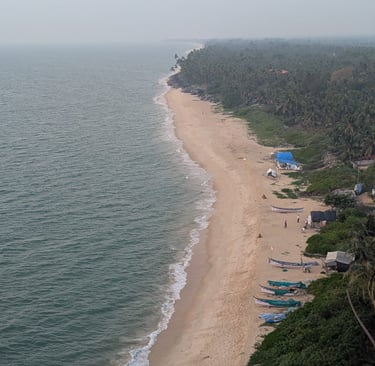
The city’s beaches further reinforce this people-centric approach. Cleanliness here is supported by infrastructure, not just intent. Changing rooms, shower facilities, toilets, seating benches, recreational provisions like cricket practice nets, food melas, and even kites with lights for night-time activity make the beach a truly inclusive public space. The lighthouse adds a strong visual anchor and becomes a focal point for both orientation and leisure.
A highlight of the visit was St. Mary’s Island, a naturally formed landscape that has been maintained with remarkable sensitivity. Despite being a fragile natural asset, it is clean, organized, and thoughtfully managed. What caught my eye as an urban designer was the creative reuse of materials—plastic bottles repurposed into placemaking elements such as entrance gates and structures, coconut tree trunks used for seating and benches. These interventions are modest yet powerful, reinforcing sustainability without appearing forced or tokenistic. Safety measures are clearly in place, ensuring that ecological preservation and tourism coexist responsibly.
Across the city, road junctions are signalized, and placemaking elements appear consistently at nodes and intersections. Importantly, these interventions are not generic. They are deeply rooted in local context—responding to regional identity, materials, and cultural narratives. This contextual placemaking strengthens the city’s character rather than diluting it.
From an urban design perspective, Udupi may not present itself as a flashy or overtly “designed” city—but that is precisely its strength. It demonstrates how discipline, thoughtful planning, respect for heritage, and user-oriented infrastructure can collectively create a high-quality urban experience. Udupi shows us that good urbanism doesn’t always shout; sometimes, it quietly works—efficiently, inclusively, and sustainably.